Project Video
Robotics
[TurtleBot Text-Control Navigation Using Camera (OCR-Based Control System)]
An intelligent TurtleBot system that uses a camera and OCR (Optical Character Recognition) to read directional text (e.g., “left”, “right”, “forward”) and autonomously controls robot movement based on the detected instructions in real time.
Overview
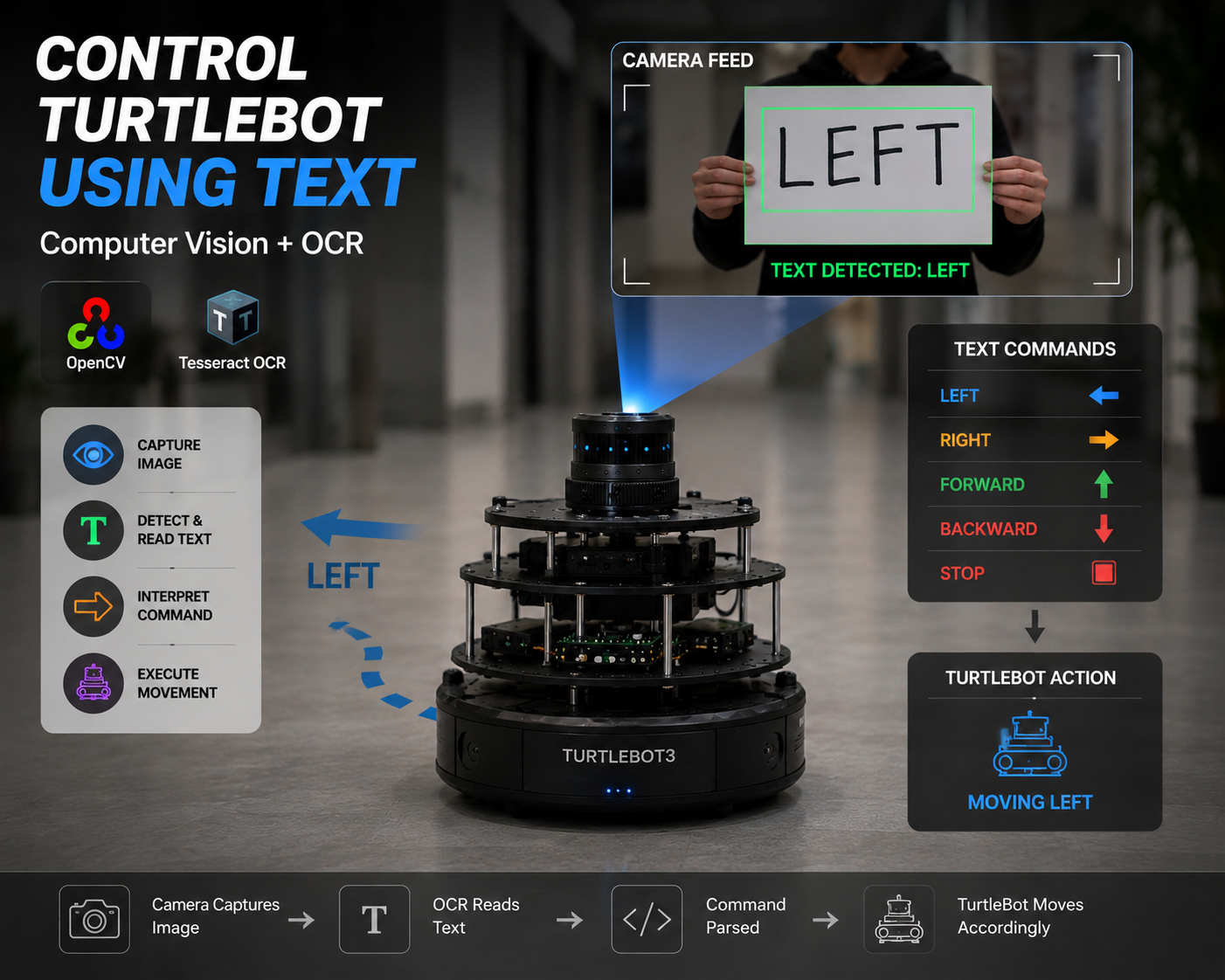
This project implements a vision-based control system for a TurtleBot where robot movement is driven by reading text instructions from its camera feed. Using Optical Character Recognition (OCR), the robot is able to interpret simple directional commands such as left, right, forward, and stop, and convert them into real-time motion commands.
The system simulates a human-like interaction where written instructions in the environment act as control signals for the robot. This makes it an intuitive and flexible interface for robot navigation without traditional remote controllers.
How It Works
The TurtleBot continuously captures frames using its onboard camera. Each frame is processed using OpenCV and passed through an OCR engine (such as Tesseract or EasyOCR) to extract any visible text.
Once text is detected, the system performs keyword matching:
- “left” → robot turns left
- “right” → robot moves right
- “forward” → robot moves forward
- “stop” → robot halts immediately
The extracted command is then published as a movement instruction using ROS topics, which control the TurtleBot’s motors in real time.
A filtering step is used to reduce noise and improve accuracy by ignoring irrelevant or unclear text detections.
Features
- Real-time camera-based text recognition
- OCR-powered command interpretation
- Autonomous robot navigation based on visual input
- ROS-based motion control integration
- Lightweight keyword detection system
- Low-latency decision making
- Camera-driven human–robot interaction
Technologies Used
- Python
- ROS / ROS2
- TurtleBot3 Burger
- OpenCV
- Tesseract OCR / EasyOCR
- NumPy
- Linux (Ubuntu)
- Camera Vision System
- Robot Operating System Communication (ROS Topics & Nodes)
Applications
- Human–robot interaction systems
- Assistive robotics
- Smart warehouse instruction robots
- Educational robotics demonstrations
- Vision-based control systems
- Industrial automation prototypes
- AI-driven command interpretation systems
Learning Outcomes
This project improved skills in:
- Computer vision and OCR processing